Wednesday, November 4, 2009

Building With Whole Trees

keywords:
Source: New York Times , Whole Tree Architecture

ROALD GUNDERSEN, an architect who may revolutionize the building industry, shinnied up a slender white ash near his house here on a recent afternoon, hoisting himself higher and higher until the limber trunk began to bend slowly toward the forest floor.

“Look at Papa!” his life and business partner, Amelia Baxter, 31, called to their 3-year-old daughter, Estella, who was crouching in the leaves, reaching for a mushroom. Their son, Cameron, 9 months, was nestled in a sling across Ms. Baxter’s chest.

Wild mushrooms and watercress are among the treasures of this 134-acre forest, but its greatest resource is its small-diameter trees — thousands like the one Mr. Gundersen, 49, was hugging like a monkey.

“Whooh!” he said, jumping to the ground and gingerly rubbing his back. “This isn’t as easy as it used to be. But see how the tree holds the memory of the weight?”

The ash, no more than five inches thick, was still bent toward the ground. Mr. Gundersen will continue to work on it, bending and pruning it over the next few years in this forest which lies about 10 miles east of the Mississippi River and 150 miles northwest of Madison.

Loggers pass over such trees because they are too small to mill, but this forester-architect, who founded Gundersen Design in 1991 and built his first house here two years later, has made a career of working with them.

“Curves are stronger than straight lines,” he explained. “A single arch supporting a roof can laterally brace the building in all directions.”

The firm, recently renamed Whole Tree Architecture and Construction, is also owned by Ms. Baxter, a onetime urban farmer and community organizer with a knack for administration and fundraising. She also manages a community forest project modeled after a community-supported agriculture project, in which paying members harvest sustainable riches like mushrooms, firewood and watercress from these woods, and those who want to build a house can select from about 1,000 trees, inventoried according to species, size and shape, and located with global positioning system coordinates, a living inventory that was paid for with a $150,000 grant from the United States Department of Agriculture.

According to research by the Forest Products Laboratory in Madison, run by the USDA, a whole, unmilled tree can support 50 percent more weight than the largest piece of lumber milled from the same tree. So Mr. Gundersen uses small-diameter trees as rafters and framing in his airy structures, and big trees felled by wind, disease or insects as powerful columns and curving beams.

Taking small trees from a crowded stand in the forest is much like thinning carrots in a row: the remaining plants get more light, air and nutrients. Carrots grow longer and straighter; trees get bigger and healthier.

And when the trees are left whole, they sequester carbon. “For every ton of wood, a ton and a half of carbon dioxide is locked up,” he said, whereas producing a ton of steel releases two to five tons of carbon. So the more whole wood is used in place of steel, the less carbon is pumped into the air.

These passive solar structures also need very little or no supplemental heat.

Tom Spaulding, the executive director of Angelic Organics Learning Center, near Rockford, Ill., northwest of Chicago, knows about this because he commissioned Mr. Gundersen to build a 1,600-square-foot training center in 2003. He said: “In the middle of winter, on a 20-below day, we’re in shorts, with the windows and doors open. And we don’t burn a bit of petroleum.”

“It’s eminently more frugal and sustainable than milling trees,” he added. “These are weed trees, so when you take them out, you improve the forest stand and get a building out of it. You haven’t stripped an entire hillside out west to build it, or used a lot of oil to transport the lumber.”

Mr. Gundersen had a rough feeling for all of this 16 years ago, when he started building a simple A-frame house here for his first wife and their son, Ian, now 15. He wanted to encourage local farmers to use materials like wood and straw from their own farms to build low-cost, energy-efficient structures. So he used small aspens that were crowding out young oaks nearby.

“I would just carry them home and peel them,” said Mr. Gundersen, who later realized he could peel them while they were standing, making them “a lot lighter to haul and not so dangerous to fell.”

Mr. Gundersen, who built most of the house singlehandedly, also recognized the beauty of large trees downed by disease or wind, and used the peeled trunks, shorn of their central branches a few feet from the crook, as supporting columns in the house. “I thought they were beautiful, but I didn’t think how strong they were,” he said.

“In architecture, how materials come together and how they are connected is really the god in the details,” he continued. “The connection is where things will fall apart,” he said, adding that the crook of a tree “has been time-tested by environmental conditions for 200 million years.”

He refers to that first house — which cost $15,000 (for plumbing, electrical, septic and other basic amenities, as well as $4,000 in paid labor) and a year of his own labor — as his master’s degree in architecture. Divorced in 1997, he now lives there with Ms. Baxter and their two children.

After finishing the A-frame, Mr. Gundersen built a 100-by-20-foot solar greenhouse next door with thick straw-bale walls on three sides, banked into the north slope. He used small-diameter, rot-resistant black locust trees for the timber framing.

A wall of double-paned glass, positioned to optimize the low-angle winter light, faces south. Growing beds angled slightly toward the sun are planted with rows of mustard greens, kale, chard, arugula, lettuces and herbs. Hanging trays of micro-greens and a fig and bay tree promise fresh food for the fall and winter.

But it is the Book End — the little house attached to the greenhouse, which is home to the firm’s project manager and his wife — that quietly vibrates with the spirit of the forest.

“We used a lot of standing dead elm here,” Mr. Gundersen said, pointing out the delicate trails, or galleries, left by the beetles that killed the tree. Peeled of their bark and satiny smooth, these trees have a presence that seems to draw one’s arm around their trunks and invite a viewer to lean into them, to soak up strength from these powerful old souls.

In this quiet farming community, where people may not have a lot of money to spend, but do have plenty of wood and straw, word of the beauty and practicality of Mr. Gundersen’s structures has spread. Solar greenhouses made of local materials can extend the growing season through winter, even in a place where temperatures can drop to 30 or 40 below. In the last 18 years, Whole Trees has built 25 of them here.

It’s part of a vision Mr. Gundersen developed after spending three years as a project architect on Biosphere 2, the three-acre glass-enclosed miniature world constructed near Tucson in the 1980s, which tried to replicate the earth’s systems, but foundered on carbon dioxide, acidic seas, failed crops and internal intrigues. After that experience, he wanted to build something more basic to human needs.

Mr. Gundersen grew up in nearby LaCrosse, where his Norwegian great-grandfather, a doctor, founded a local institution, the Gundersen Clinic; he comes from a clan of doctors and tree lovers. “There are 23 doctors in the family,” he said, including his father and uncle and four great-uncles, but he seems to be wired more like his great-grandmother Helga, whose family still owns a tree farm in Norway. He and his grandmother would often picnic on this piece of wild land, where he remembers picking watercress and wildflowers and building tree forts.

Now, to be in his buildings is to be among the trees.

“It almost feels like we’re in a forest, the trees have such a presence,” said Marcia Halligan, a client who is a farmer and Reiki instructor, standing among the birch posts of her airy bedroom.

She and her partner, Steven Adams, who grows seed for organic seed companies, worked with Mr. Gundersen on a design that uses 22 different kinds of wood, most of it from their own land outside Viroqua, southeast of Stoddard.

The economic downturn has put commissions for several large buildings for nonprofits and a 4,600-square-foot residence on hold, Mr. Gundersen and Ms. Baxter say, but the demand for small houses like theirs is up.

“It’s remarkable how many people have called this last year asking for 1,000-square-foot houses,” Ms. Baxter said. “People are downsizing for their retirement homes, and even younger folks are thinking about energy costs, environmental awareness and simplicity.”

Whole Trees can keep construction costs as low as $100 a square foot, not including site preparation, if the client is willing to shop for secondhand fixtures and the like.

As people begin to see forests as a resource, they may begin to take care of them rather than cutting them down to make room for cornfields or pastures. And the forests keep giving back.

“I’ve taken 20 trees per year off one acre, for 12 buildings,” Mr. Gundersen said. “You can never tell that we’ve taken out that much wood.”

Thursday, October 29, 2009

Vision for a Vegetal City

keywords: nature, urban planning, vision for the future
source: Vegetal City, Inhabitat


Ever wonder what our modern-day cities could look like 100 years from now in a perfect world? Architect Luc Schuiten endeavors to find out with his Vegetal City installation, currently on display in Brussels. The entrance, made up of an archway with branches covered in blinking yellow lights, leads the exhibit’s visitors into a magical world of architectural drawings and models of cities where city residents live peacefully with nature.
According to the 65 year-old architect, “You cannot feel good in light of all the environmental pollution and the grim perspectives for the future.” Instead Schuiten, a self-proclaimed utopist, sketches alternatives.

Among the cities of the future on display are the Lotus City, the Woven City, the Treehouse City, and the City of the Waves. Each city takes on a unique character based on its environment. The Woven City, for example, features habitats made up of a “vegetal mesh” formed by the roots of a strangler fig tree wrapped around the host tree. The fig tree grows so tall that buildings can be built into it. Buildings are made from biotextiles that capture solar power for electricity.

Schuiten’s designs are fantastical, sure, but they offer an inspiring vision of what cities in harmony with their surroundings might look like.


Evolution of the city (click the image to see lager image)


Overview


The Woven City


The Lotus City

Urbancayon

The City of the Waves


Building Model


Ornithoplanes with flapping wings


cyclos


The click car


The tractainer


This vision for a vegetal city first reminds me the Art Nouveau style. It is like the concept of art nouveau applied on a huge scale of city planning.

One question that triggers my interest is: if we use natural form in the urban scale, what would the difference between natural and urban be? I think this question is really interesting because it calls us to look at the very purpose of urbanlization and the implication of urban form. Do we really want to go that far in abandon our urban form in order to achieve sustainability? Although our current urban form creates a lot of pollution and unsustainable issues, it still symbolize the great civilation of human beings. And there are profound social, cultural and historical implications that make it so important to us. I guess Luc Shuiten's vegetal city may be very good to use at creating a new city from nothing. It may be very easy to transform the existing nature into this vegetal city with relatively low cost. As for the great cities such as New York, Paris which we've have for such a long time, I guess it is better to keep as it is and thinking about some other ways to "greenalize" the urban space.

Friday, October 23, 2009

7 Eco-fabric that could change the future of fashion

Keywords: eco-fashion, green material
Source: treehugger

Cork \ˈkȯrk\
n. 1 a: An impermeable, buoyant, fire-resistant material that is stripped from the bark of the cork oak every nine years. (The tree has an average life expectancy of 200 years.) b: Used in flooring, upholstery, clothing, accessories, and, of course, wine stoppers. c: A strong case for the conservation of cork oak landscapes, which support remarkable levels of forest biodiversity, including endangered species such as the Iberian Lynx, the Iberian Imperial Eagle, and the Barbary Deer.

SeaCell \ˈsē ˈsel\
n. 1 a: A variant of lyocell, SeaCell is made by combining cellulose with a small percentage of seaweed. b: Boasts a litany of health claims, including stress reduction, detoxification, the exchange of minerals and vitamins between fiber and skin, and a “complete sense of well-being.” c: The subject of controversy when the New York Times reported that the lab tests it had commissioned found no seaweed in a Lululemon shirt made of VitaSea, which was made of SeaCell. The yoga-apparel company disputed the Times’ findings with its own tests, but it agreed to remove any unsubstantiated therapeutic or performance claims at the request of Canada’s Competition Bureau.


PIÑA FIBER \ pēn-yə fī-bər\
n. 1 a: Long, fine, lustrous fibers obtained from the leaves of pineapple plants. (The plants are typically cultivated in Hawaii, the Philippines, Indonesia, India, and the West Indies.) b: Resilient, strong fibers often used for sheer, silky fabrics, ropes, twine, and paper. c: Piña cloth is wear-resistant and easy to clean, making it an ideal eco-textile for clothing, accessories, and home-design solutions. Eco-couture designers and the royals of the Phillipines swear by its luxe, soft qualities and use it to make the traditional Barong Tagalog embroidered ceremonial garment.


LENPUR \ˈlen-ˈpər\
n. 1 a: A fiber made from the pulp of sustainably cultivated white fir wood. b: Has an exceptionally soft weave that feels similar to cashmere. c: Used in clothing, underwear, socks, and home accessories, Lenpur is said to have thermoregulatory, odor-eliminating, and absorbent properties.

BANANA FABRIC \ bə-ˈna-nə ˈfa-brik\
n 1 a: A Southeast Asian cloth derived from the cast-off stems and leaves of the banana tree. b: The coarse outer layer is commonly used for woven tablecloths, cushions, seating, and curtains, while the inner, silky layer is ideal for fine saris, kimonos, and eco-couture designs like the Doo-Ri dress above. c: “Jusi,” or banana fabric/fiber is popular in Nepalese artisan workshops for the production of handcrafted, knotted rugs.


SALMON LEATHER \ˈsa-mən ˈle-thər\
n. 1 a: A dyeable textile made from salmon skin—a byproduct of the fish processing industry that usually gets tossed into the landfill—using chemicals that are less toxic than those for tanning mammal hides because fish scales are easier to remove from skin than hair. (Note: no new salmon is killed expressly for its skin.) b: A resilient fabric that is stronger than most land leathers—and does not smell like fish. c: A reliable, affordable source of “sea leather” used by companies such as ES Salmon Leather, One October, Unnurwear, and Skini London in clothing, accessories, furnishing, home decor, and even bikinis.
Salmon leather was recently used in the form of die-cut paillettes by fashion designer Isaac Mizrahi to create an entire ensemble (jacket, dress, open-back shoes) for the Nature Conservancy’s “Design for a Living World” exhibition at the Cooper-Hewitt Museum in New York City.


TENCEL \ˈten ˈsil\
n. 1 a: The trademarked brand name for lyocell, a natural cellulosic fiber with excellent moisture absorption and an exceptionally silky hand. b: A dyeable, wrinkle-resistant material that can be blended with a variety of other fibers, including cotton, rayon, polyester, silk, hemp, linen, and wool. c: Fabricated using a closed-loop process that doesn’t require bleach, although some manufacturers may use chemical processes, enzyme baths, and dyes that may or may not be environmentally sound.

When talking about eco-fashion, what first jump into our mind may be a ragged paper clothes, brown bag coat, nespaper dress. Thanks to the great advances in technology, eco-fashion no longer need to take those worn and ragged appearance; they can be just like regular fabrics with green concepts inherently incorprated in.

Traditional fabrics may use a lot of chemicals to produce, which will create enormous pollution to our environment. By using natural raw material, we can avoid the chemical synthesize process. However, if we still need to use chemicals to bleach and dye these eco-fabrics is still a question worth thinking about. Also, how to grow and use these natural materials in a moderate amount without endanger the species or overgrow the species is another question that needs close cooperation with the ecologists.

Tuesday, October 20, 2009

Architectural Fashion: Frank Gehry for Lady Gaga

Keywords: Architecture, Fashion
Resources: ArchiDaily, The New Yorker

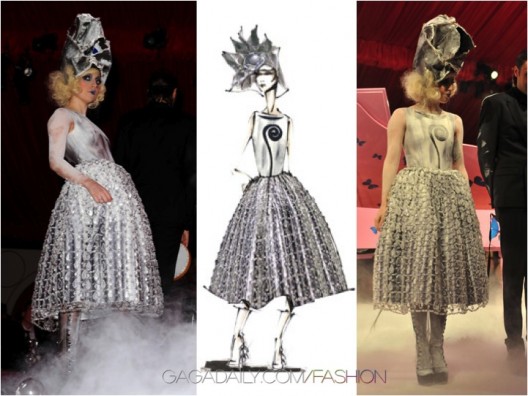
After Beekman Tower's topping off ceremony, we didn't think we could be surprised by anything Frank Gehry said or did any more. That is, until Archpaper pointed us to the news that Gehry designed a hat for Lady Gaga to wear to a benefit at LA's Museum of Contemporary Art. It sounds like the move from buildings to headgear was a little challenging for our favorite Canadian-born starchitect, who drew the initial design for the hat on his iPhone: "Since I've never designed a hat before, I was afraid she wouldn't be able to walk....I did have an idea that involved people with sticks holding it up, walking behind her. I didn't know how far I could go with this thing." Thanks to photos from Gaga Daily, we know exactly how far he went, and it doesn't quite stop us from wishing for people with sticks. Next time, Gehrmeister.

An Article on Lady Gaga, Frank Gehry on the New Yorker:

Celebromatic
The other day, Francesco Vezzoli, an Italian artist known for his meta-spectacles—an advertisement for a fake perfume called Greed, directed by Roman Polanski; a trailer for a fictional remake of Gore Vidal’s “Caligula,” with him and Courtney Love sharing the title role—turned up in the offices of the architect Frank Gehry with a Prada shopping bag. “Hi, kiddo,” Gehry—small, buoyant, gnomish—said. (They go back.) Out from the bag came a hat stand, on which a large silver leather headdress brooded like an alien hen: Gehry had designed it, at Vezzoli’s behest, and Prada had fabricated it, for the avant-garde, hat-friendly pop star Lady Gaga to wear during a performance with dancers from the Bolshoi Ballet, to benefit the financially troubled Museum of Contemporary Art in downtown Los Angeles.

“Yee-hoo!” Gehry squealed. “Lookie this! Wow! I wouldn’t wear it, but—has she tried it on yet?” (She had not.) “I would open it up a little,” he said, pulling back the silver wings to reveal a glittery translucent bauble, like a giant superball or an all-seeing eye. He touched it. “Can that be more silver?” Gehry said that he had done the initial drawing on his iPhone, which an assistant then produced: a violet scribble with a black-and-blue iris at the center. “Since I’ve never designed a hat before, I was afraid she wouldn’t be able to walk,” he said. “I did have an idea that involved people with sticks holding it up, walking behind her. I didn’t know how far I could go with this thing.”

Vezzoli’s spectacle, “Ballet Russes Italian Style (The Shortest Musical You Will Never See Again),” went up the following Saturday. That afternoon, Lady Gaga rehearsed in a tent, which had been erected for the gala on the street in front of the museum—it was draped in red satin and velvet and displayed a movie-palace marquee out front. (“It’s disco-Kremlin in the middle of the freeway,” Vezzoli said. “It’s beyond kitsch. It’s literally like a night club for the orgies of Communist plutocrats.”) She took the stage slowly, in the manner of a boozy granny. It might have been her shoes: spike-heel black patent-leather lace-up dominatrix boots, paired with ripped fishnets, a studded leather vest, a black leotard slit to the navel, and sunglasses that never came off. Her hair was a tangle of white-blond cotton candy streaked with pink. It matched the piano—pink, with cobalt butterflies painted on it—customized by Damien Hirst. The Hirst piano was reminiscent of the bubble-filled piano she played on her last tour, which was based on a Hussein Chalayan dress.

Gaga gazed at the instrument. “Holy mother, that’s unbelievable. Is it a Steinway?” she said. “Steinways are the best. The butterflies are so pretty.” She played “Speechless,” a song that would début that night, and, as the dancers twirled, the stage, like a mechanism in a child’s jewelry box, began to rotate. When the song was over, she peered out into the darkened tent, tilting her head down so she could see over her shades. “Holy mother,” she said again, and went to her tour bus.

Inside, Gaga, who is twenty-three and speaks with a prim grandeur that might have come from watching old movies, sank into a nubby upholstered seat. “I wear this all the time,” she said, yanking closed her gaping leotard. “This is like my sweatpants.” She rattled off her inspirations: Leigh Bowery, Klaus Nomi, David Bowie, Grace Jones. “It is that moment of fashion, that moment of performance, and that moment of music, combined with art and love, that makes what Gaga is all about,” she said. She sprang up and surveyed her borrowed finery: the Gehry hat; a grayish satin dress with a skirt of chandelier crystals (designed by Vezzoli and Miuccia Prada, after the costume that Giorgio de Chirico made for Diaghilev’s “Le Bal”); a brass-and-crystal mask, by Baz Luhrmann and Catherine Martin; a pair of tall clear plastic boots with black buttons up the side. “I helped design the shoes,” Gaga said. “They’re supposed to look like spats, and they’re just under the knee, a bit more of a tea length.” She said she felt at home in the world of contemporary art. “The objective is to always be making something that belongs in a museum. Even what I’m wearing right now.”

Night fell, and the guests began to arrive: artists, politicians, actresses, the old, rich, concerned citizens of Los Angeles, and Wladimir Klitschko, the Ukrainian heavyweight champion. (They were, to Vezzoli’s mind, the ultimate extras.) Teacups of borscht and tiny devilled quails’ eggs went around on trays. Tavi Gevinson, a thirteen-year-old fashion blogger with a small, pale face and Mia Farrow hair, had flown in from Chicago and was dressed in Rodarte. (The Rodarte sisters were her babysitters for the night.) “God—Hamish!” she said, swooning a little when she saw Hamish Bowles, an editor at Vogue. “He’s the coolest.” At the dinner hour, Gevinson took her place, along with Gwen Stefani and Brad Grey, at the table of Dasha Zhukova, a twenty-eight-year-old Russian contemporary-art lover and oligarch’s daughter who was an honorary co-chair of the event. (Roman Abramovich, another art-loving oligarch, is her partner and soon to be the father of her child.)

Performance art was on everybody’s mind. Three girls in matching golden diadems—the heiresses Tatiana Santo Domingo, Eugenie Niarchos, and Margherita Missoni—proclaimed themselves a “visual art act.” “We’re a cross between the Spice Girls and Burning Man,” Missoni said, dissolving in giggles. The blogger Perez Hilton, who says he is “Gaga’s No. 1 fan,” was wearing a black hoodie with glitter pin-stripes, from American Apparel, and white sunglasses. “The public persona of me is so different from who I really am,” he said, gesturing at his ensemble. “I wouldn’t wear this, Perez would wear this. I don’t wear sunglasses inside, Perez does. This is acting! It’s also good because if I see Rachel Zoe or someone I don’t want to look at I don’t have to make eye contact.” He paused, and took a swig of red wine. “She’s here.”

The spectacle went by in a flash. Perez sang along to “Speechless” in an otherwise hushed room. Gaga wore the Gehry hat all folded in on itself, a millinery version of Walt Disney Hall. (“She has a thing about showing her eyes—she doesn’t like to—so she closed it up,” Gehry said, over a miniature baked Alaska, afterward. “It’s O.K.”) The piano was auctioned off for four hundred and fifty thousand dollars to Larry Gagosian, Hirst’s dealer, who was the other honorary co-chair of the event. (The gross receipts for the night were four million dollars.) After a while, Gaga reëmerged, hatless, with black lipstick daubed at the center of her mouth, the geisha way, looking—an effect of heavy makeup—as if someone had punched her in both eyes. “This is the most heady night of my life,” she said, as Perez introduced her to Pharrell Williams, the musician and producer. “Whenever you start your next album, I would love to give you a mean up-tempo,” Williams said. “I was probably the last one to get it, but, now that I got it, there’s no other artist. It’s not whether you have blue eyes or a fat ass or can rhyme—it’s about a great performance, it’s about a performer willing to be theatrical beyond.”


This entry may be a little bit off my green-design topic, but I thought it is good to post it with this week's fashion design topic. Frank Gehry's architecture has been famous for its highly idiosyncratic, deconstructive form. Gehry's works go against traditional form, question the possibility of shapes. Looking at Gehry's work is just like looking at buildings that can only stand in the world of impossibility. Lady Gaga, this superstar in the current music world, is also famous for her rebellious, unusual music style. Let Gehry design costume for Gaga is undoubtedly the most amazing conversation between the architecture world and the fashion and music world.

We can see very clear features of Gehry's deconstructism style in Gaga's hat. The irregular and shapes and volumes reminds us Gehry's masterpiece, the Guggenheim Museum in Bibalo, Spain. I'm sure when Gaga wears the Gehry hat singing and performing, there must will be more dynamism instilled into Gehry's scultupure like hat. It is just going to be like letting Gehry's building model dance in the music. This interdialogue between architecture, fashion and performing arts reminds me another similar attemp made by Yves Saint Laurent, the famous French fashion designer. He once did a series couture with the style famous 19th centure artists. In that collection, there was "A Tribute to Vincent Van Gogh", where Van Gogh's Irises is used as the undulating patterns on the dress. Similarly, there were also coutures titled "A Tribute to Henri Matisse", "A Tribute to Paul Cezanne", etc. This example also proves that all forms of art are so tightly interconnected with each other, and they are constanly influencing and learning from each other.

Thursday, October 15, 2009

A House Made of Papers


Keywords: prefab, recycled materials
Sources: New York Times

A DESIGN-SAVVY friend called. She had an appointment in the just-opened sales office of the Metal Shutter Houses, an 11-story condominium designed by the Japanese architect Shigeru Ban, in what is now West Chelsea.

I’m a big fan of Mr. Ban’s work. I love the way he uses ordinary materials to create sublime spaces. I have dreamed about living in the house in Tokyo he designed with its cloudlike billowing curtains. I was eager to see what he would come up with for a luxury building in Manhattan.

Mr. Ban’s project, at 524 West 19th Street, is being developed by Jeff Spiritos, the president of HEEA Development L.L.C., and Klemens Gasser, a Chelsea art dealer. It was still a hole in the ground when we visited, the site shoehorned between the IAC headquarters building by Frank Gehry (love that cool iceberg) and another glass-and-steel building by Annabelle Seldorf. The two buildings give that block of 19th Street a lunar feeling, which was heightened by the gray light of late autumn.

I hurried across the street to find my friend already looking at floor plans in the sales office. If I had been a serious buyer I would have been, too. The office had only been open a few days, but the units were going fast.

Inside, Madeline Hult, a sales director at the Corcoran Sunshine Marketing Group, was turning on the video that demonstrated the condo’s star turn: the series of retractable perforated metal shutters and big windows that allow the apartments to be wide open to the elements.

Love it, I thought. But I was also wary of power failures, and couldn’t help but wonder how practical it was to have those windows in a city with good weather only half of the year. But soon, my friend and I were being swept away by the sheer ingenuity of the scheme and the opening and closing, appearing and disappearing metal shutters in an extraordinary architectural ballet.

We were in a trance as Ms. Hult was describing walls that slipped away to disappear behind cabinets, 20-foot ceilings, staircases with glass banisters, radiant heat in the floors and the all-white kitchens and bathrooms sculptured out of Corian.

The project, in which Mr. Ban collaborated with the New York architect Dean Maltz, is, at least for me, a fantasy of modern living: a pure and yet high-tech space that can be open to the air and views. On the inside, nothing will interrupt the smoothness of the surfaces.

“Shigeru does not like to show air-conditioning ducts,” Ms. Hult said. Come to think of it, neither do I.

But actually living up to living here was another issue. The sky-high prices were, of course, a restraint. But strangely, so were the elegance, clarity and transparency of the spaces. I’m way too messy and too much of a collector; I’d sully the perfection of the rooms. On the other hand, maybe I was just being defensive.

Of the original eight units only two are still available: Unit 6 has 4,644 square feet and is a full-floor duplex with four bedrooms, five bathrooms, a library, a dining room and five private outdoor spaces. It has a price tag of $10.25 million. Unit 7 has 1,949 square feet of space with three bedrooms, three bathrooms and three outdoor spaces for $4.1 million.

The prices take one’s breath away, but my friend was still interested. She’s worried that she could only move in with a few pieces of clothing, and that her grandchildren would have to leave their toys at home.

But maybe if all goes well, she’ll invite me over.


Friday, October 9, 2009

Energy Generating Pavement Hits the Streets

Keywords: eco-technology
Source: Pavegen, World Architecture News


According to inventor Laurence Kemball-Cook a paving stone on a busy street is stepped on by more than 50,000 pedestrians everyday and he’s seen the light by harvesting that pedestrian power. Every time the rubber Pavegen stone is stepped on, it flexes 5mm and the dynamo technology stores the kinetic energy produced.

The Pavegen System could power lights, computers, automatic doors and ticket machines at tube stations information displays, street lighting, shop frontages, train and bus timetables and wayfinding solutions.

The slab glows when stepped on indicating that energy has been generated to users. Five paving slabs distributed over a section of a pavement will provide sufficient power to illuminate a bus information panel overnight.

Details:
- Retro-fitted into pavement/ flooring in either interior or exterior spaces.
- The public can actively take part in the energy saving process themselves and there is a strong visual link between the slab and a sustainable attitude.
- Depending on the application, the buy back period can be 1 year or less.

Power:
- Each slab generates 2.1 watts per hour when located in an area with high footfall. Based on a hit rate of a footstep every 4-10 seconds.
- Testing at trial sites has shown that 5 hours of walking at peak time will generate enough power to illuminate a bus stop for over 12 hours.
- 5% of the energy generated per footstep is used to illuminate the central low energy LED lamp.
- Energy is stored within Lithium Polymer batteries: opt. A: 1 battery per 5 unit or opt. B: One battery per unit. Depending on functionality of system.

Materials:
- Top surface: recycled rubber car tyres, internal components: recycled aluminium and the exterior housing is marine grade 316 stainless steel.
- Toughened clear glass with an optical film.

Durability:
- The system requires annual servicing and is designed to withstand 5 years of use equating to 20 million steps in interior and outdoor environments.
- Removable gear tray allows hassle free servicing taking just minutes.
- Engineered to withstand harsh winter conditions without corrosion.

Vandalism:
- Anti-tamper stainless steel bolts are used to prevent unauthorised personnel accessing unit.
- Shock absorbing dampeners to prevent damage to mechanism when large vehicles and high impacts affect the pavegen slab.

Installation:
- Retro-fitted into pavement/ flooring in either interior or exterior spaces.

Colours:
- Available in a variety of colours including grey, red, blue and other mixes.
- Custom branding options: To promote your brands sustainability credentials, Logos can be added to central lamp as shown or etched onto glass.

Trials will take place in several locations throughout the UK in early 2010 with local authorities, schools and airports. Pavegen was designed by Laurence Kemball-Cook who is director of Pavegen Systems ltd. Laurence worked on sustainable blue sky research lighting projects while working as an Industrial Design engineer at Eon UK plc. Pavegen is developed in conjunction with Loughborough University and Advanced leds ltd over a two year period.

Tuesday, October 6, 2009

Solar Powered Shoes


Keywords: green-technology
Source: eccoterre

Using the included solar cells and LEDs, any set of sneakers can be quickly finessed into surreal garden or street lighting. The kit comes in two sizes—kid and adult—and is available with white or colored (”mood-changing”) lights. Toss one on the ground to illuminate the doorway of your home at night, or fling a pair into a tree—in the spirit of shoe-tossing—to puzzle passers-by.

Both entries of this week are related to the new energy generating technology. Interestingly, both technology look at improving the walking experience of pedestrians, and transform the walking energy into electricity. This idea is great in that it not only create another way to generate electricity, but the energy generated is directly used for improving the pedestrians' walking experience, which may further more encourage more people to use walking as their priliminary means of transportation.
These two designs also call up our attention on much energy we used on lighting the streets at night. It is a inconsiderable amount of energy but for the safty reason we cannot it. Generating electricity by pedestrians themselves solve the problem of keeping street lights on all the time. Maybe we can extend this techonoly even to cars and other vehicles, build in electricity generating panel on the streets and highway so that light only turns on when there are cars passing by.