Friday, November 27, 2009

World's Largest Mountain Towers Over Berlin

Keyword: artificial nature

German architect Jakob Tigges has unveiled a plan for a 1,000m tall faux mountain at the site of the former Tempelhof airport in Berlin, and his supporters are taking it rather seriously. Dubbed “The Berg,” the snow-capped colossus would be the world’s largest man-made mountain and would serve as a tourist attraction for skiers in the otherwise slope-less city. We’re all about adding green space to urban environments, but devoting an enormous amount of time, energy and resources into a gigantic landmass that isn’t even inhabitable on the inside seems like a huge mound of you-know-what, if you ask us.
Plans for The Berg seem to have spawned out of a severe case of “peakis-envy”. Says Tigges in his manifesto “While big and wealthy cities in many parts of the world challenge the limits of possibility by building gigantic hotels with fancy shapes, erecting sky-high office towers or constructing hovering philharmonic temples, Berlin sets up a decent mountain… Hamburg, as stiff as flat, turns green with envy, rich and once proud Munich starts to feel ashamed of its distant Alp-panorama and planners of the Middle-East, experienced in taking the spell off any kind of architectural utopia immediately design authentic copies of the iconic Berlin-Mountain.”

While it may seem counterintuitive to think that building a massive office building or condominium is more environmentally friendly than a mountain, it’s important to point out that inhabitable buildings cram tons of useful space onto relatively small footprints while a mountain (which from the renderings appears to be filled-in with no livable space inside) occupies a huge footprint while providing almost no other use than a place to enjoy outdoor sports.

While it remains unclear whether or not The Berg is an actual project with plans of being built or simply one man’s pie-in-the-sky dream, the concept has already become a hit on Facebook with almost 3,500 fans and has been published by multiple outlets in the German press. What do YOU think? Is The Berg worth building or just a mountain of unsustainable rubbish? Sound off by commenting below.

Source: Inhabitat
"The Berg" Official Website: http://www.mila-berlin.com/theberg/#


Comment: The building of this huge man-made mountain throws what we usually thought as "green design" into question. When talking about a mountain, one would usually associate it with green, good for nature. However, can an artificial mountain bring exactly the same green effect as a natural mountain does? When taking all the money and labor cost into consideration, building an artificial mountain may not be cheaper than building an office building or a commercial building. Furthermore, if we take the output of the investment into consideration, building an artificial may even be a worse plan: the mountain can do nothing but create a outdoor activity space, while building an office building may generate more social and economical effect. Furthermore, if we want green space, we can also achieve this by buiding a green roof on top of the office buildings.
Building this massive berg in the center of this city of Berlin may be a good experiment in artificial biosphere, but its economic cost should still be put into doubt. This reminds us to relook at sustainable design--something that looks green may not necessarily be sustainable. We should comprehensively review all aspect of the design process before making the conclusion of if a project can be considered "sustainable".

Sunday, November 22, 2009

EDEN FALLS: Skyscraper Zoo Topped With a Waterfall

key words: artificial nature


Comment: Visiondivision's proposal for this vertical zoo is very innovative; it is almost like a sustainable skyscraper for animals. From enclosured zoos to safari park, our vision of zoos is once more changed by this bold and creative proposal. It also invokes us to thinking about the energy we used in maintaining a zoo. In order to create an artificial climate that is resemble to the original habitat of animals, traditional zoos uses a lot of energy in maintaining the temperature, humidity and so on. The proposal of Eden Fall makes us to think about how to create and reuse these energy by the zoo itself. The idea of use the energy of waterfall by turbine and generator is very smart, and the vertical division of areas for different animals employed the same idea of vertical plant zonation.
However, there are still a lot of issues left in terms of the project's practicality. Afterall, animals are unlike plants, they may not be that easily vertically arranged as plants' vertical zonation; will certain animals feel unconfortable of living on the 5th floor of an apartment? Also, the pumping of the water to such a high level also seems to be a big problem-- the energy generated by turbines may barely compensate for the pumping power. But in all, I still think this project is a very interesting idea that's worth building. Maybe the revenues generated by zoo admission fees can sustain its cost pretty well.

Friday, November 20, 2009

A Campbell Soup House?

Keywords: Prefab
Source: inhabitat, Austin+Mergold

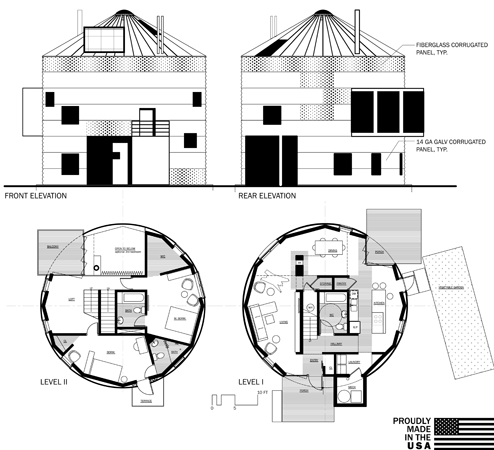
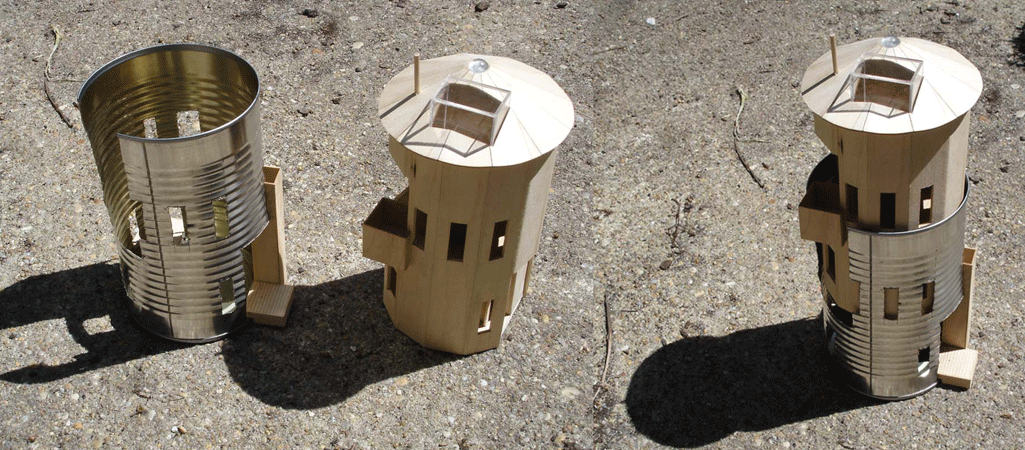
Grain silos aren’t difficult to source from farm supply companies and they are fairly sturdy, designed to withstand wind and rain while keeping the grain inside dry. Made from 14 GA galvanized corrugated steel (a little over 1/16″ thick), a grain silo could serve as a beefy, industrial looking exterior for a home. Similar in concept to using a shipping container as the shell for a project, grain silo fabrication is easily and cheaply accomplished.

The House-In-A-Can home design utilizes a 36-foot diameter grain silo and features with three levels totaling 2,000 square feet of living space. Two or three bedrooms can be located on the second level, with the living and dining space on the bottom. The top floor can be used as a deck, extended living space, or even a greenhouse. Also, multiple silos could be connected to each other to create larger homes or apartment blocks. And if you buy 5, Austin + Mergold will happily give you the 6th for free!


Tuesday, November 17, 2009

Made From Wood Pallets and Shipping Containers

Keywords: Prefab, recycled building materials
Source: Inhabitat, arch daily


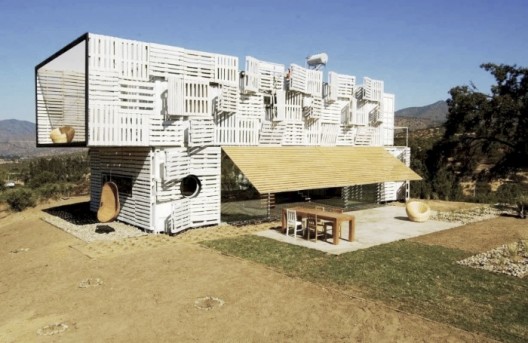
While not totally prefabricated, the Manifesto House by Infiniski utilizes pre-made materials like shipping containers and wooden pallets to create a totally rad modern house. Infiniski’s mission is to build homes cheaply and quickly using sustainable materials while incorporating renewable energy systems. They have many designs already available, which can be interchanged and easily modified.

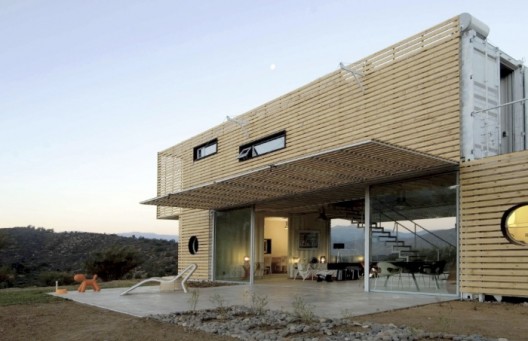
Built in Curacavi, Chile, for a grand total of 79,000€, the modest home is composed of two 40′ shipping containers and two 20′ containers. The use of wooden pallets on the exterior of the home gives it fantastic texture, but also has purpose — they provide shade and allow the home to be naturally cooled, since air can move freely between the slats. The containers meanwhile, are completely weather tight and provide the necessary structural capacity for the home.

Inside the home is airy and open due to a large living space on the bottom floor created by the placement of the containers. What seems like inexpensive storefront windows are used as the walls, which can be slid open to naturally ventilate the home. There is also a folding screen to create a covered outdoor porch or shade the interior from the sun when folded down. Geothermal heat pumps also help provide heating and cooling. The architects at James&Mau are also the founders of Infiniski, so the designs are not only design-worthy, but practical in terms of build-out.

Project: Infiniski Manifesto House
Architects: James & Mau
Location: Curacaví, Chile
Built Area: 160 m2 ( + 15 m2 terraces 2nd floor)
Landscaping: Infiniski
General Contractor and manager: Infiniski
Renewable strategy: Infiniski + Geotek
Project year: 2009
Execution Time: 90 days
Total Cost: 79.000 €
Photograph: Antonio Corcuera
Furniture: Cómodo Studio, gt_2P


Monday, November 16, 2009

Made From Recycled Shipping Containers

Keywords: Prefab, Recycled Materials
Source: Inhabitat, Envision Prefab Facebook Group

Shipping containers are known for their inherent strength, wide availability and relatively low cost — making them a practical and sustainable option for affordable housing. Last year, South Florida-based design, manufacturing and retail company, Envision Prefab set out to create a eco-conscious home, the “E-House,” constructed of sturdy cargo containers. They also wanted to educate homeowners about sustainability, so they recorded all the steps involved in retro-fitting shipping containers to construct the home and shared it with Jetson Green.

Using the framework of shipping containers to create the basic structure of the residential house, the E-House successfully combines container architecture with residential housing to provide environmentally-responsible design and construction to the housing marketplace. Ranging in size from 740-square-feet to 1300-square-feet, the homes are assembled off-site and then shipped to the specified location.

Following typical construction procedures, the assembly begins with the layout of standard cargo containers. Windows, doors, mechanical, and plumbing vents are marked out at the onset and are cut out of the corrugated metal of the containers walls. Prior to the start of construction, container walls are sand-blasted and coated with an anti-rust primer to insure maximum durability. Exterior walls are then welded together to create the desired form of the structure. When the walls of the house are in place, framing begins. Using steel studs, the exterior walls and the ceiling are framed. Subsequently, electrical, plumbing and mechanical systems are then added to the structure, as well as proper insulating. Lastly, the exterior walls are covered in the proper sheathing and house wrap while sheetrock is hung on the walls and ceilings.


Developed to meet the standards of all major green building programs and to retain the smallest carbon footprint as possible, the E-House contains a number of green features, including: energy efficient appliances, a split air conditioning system, low-flow toilets, HEPA air quality filters, tankless hot water heaters, grid-tied solar panels, an electric car charger, LED lighting, low-VOC paints, non-toxic insulation, a Solar Energy system, smart home lighting, greywater recycling, an organic waste composting machine and a custom made recycling center.


The “Agere” (coming from the word “to act” in Latin) is a 960 SQ/FT sustainable, efficient and cost affective home. This three bedroom, two and one half bath container home model proves that efficient use of space, good looks and affordability can co-exist.
Buyers of this home will enjoy a modern, sophisticated space with enough room to accommodate growing family.

Some of the Agere’s features include:
-Greywater recycling system
-Energy Star certified and energy efficient appliance package
-Low maintenance home with low utility costs
-High efficiency insulation
-Ductless A/C system
-Instantaneous hot water heating system
-Low-E windows and doors
-Low VOC paints
*Optional 1020KW solar power system

Saturday, November 14, 2009

2009 London Design Festival

Keywords: Design festival
Sources: London Design Festival, inhabitat

One of our favorite shows from the 2009 London Design Festival was Corn Craft, a beautiful showcase of sustainable materials hosted by Gallery FUMI and Studio Toogood. Held in Gallery’s FUMI’s personal live/ work space on Hoxton Square, the exhibition hit all the right notes with tactile, emotional art-design pieces by Max Lamb & Gemma Holt, Nacho Carbonell (above) and Raw-Edges Design Studio.

Raw-Edges Design Studio’s table appears to magically carry ceramic dishes from which food was served at the opening party. 60 were invited, 100+ attended!

Oscar Narud ’s crafty slotted Keel tables 002 and 003.


Very Good & Proper’s ‘Canteen Table leg set’ found value in a discarded science lab table that the designers salvaged in their university years. This set of modular legs can be attached to reclaimed wood pieces such as old doors to convert them into tables.


Scott Jarvie’s One Cut Chair has been designed to minimize energy and manufacturing time by using water-jets to create a single continuous cut into a single sheet of plywood. The chair can be adjusted slightly to suit the sitter. Jarvie is a finalist in the British Council’s UK Young Design Entrepreneur award for 2009.

Tomás Alonso’s light experiments continue the Mr Light aesthetic in a smaller series, inspired by energy-efficient T5 LED dimmable light tubes.

Seating for Eating by Studio Ilse produced by De La Espada.

Buon Appetito is Andrew Haythornthwaite and Jordi Canudas‘ creation. Feeding off unwanted paper waste, the sculptural funishing grows, providing a place to sit and rest.

Inspired by Martin Hocking research into reusable vs. disposable cups, Australian company KeepCup, take on the throwaway paper coffee cup problem. KeepCup’s Jamie Forsyth explained how each paper cup takes approximately 1000KJ of energy to produce, whereas their plastic cups take 9000KJ each to produce and can be recycled once at the end of their lifespan. Including washing, it would take 20 – 30 uses to break even with paper cup consumption. This is quite impressive when compared to a 1000 break even point with a re-usable steel coffee cup, which lasts approximately 5,000 uses. KeepCup pointed out that as fervent espresso-coffee drinkers, in the UK alone, we throw away 1.7 billion paper coffee cups each year. They have sold 50,000 to Australian public services in the last four months.


Bokja by The Quirico Company is a piece of found furniture reupholstered with beautiful vintage fabric.

Kyeok Kim’s Chair (left) made from reclaimed materials. The Easy Willow chair (right) by Cornish-based designers Boex is made from sustainable wood and British grown willow.

Wednesday, November 4, 2009

Building With Whole Trees

keywords:
Source: New York Times , Whole Tree Architecture

ROALD GUNDERSEN, an architect who may revolutionize the building industry, shinnied up a slender white ash near his house here on a recent afternoon, hoisting himself higher and higher until the limber trunk began to bend slowly toward the forest floor.

“Look at Papa!” his life and business partner, Amelia Baxter, 31, called to their 3-year-old daughter, Estella, who was crouching in the leaves, reaching for a mushroom. Their son, Cameron, 9 months, was nestled in a sling across Ms. Baxter’s chest.

Wild mushrooms and watercress are among the treasures of this 134-acre forest, but its greatest resource is its small-diameter trees — thousands like the one Mr. Gundersen, 49, was hugging like a monkey.

“Whooh!” he said, jumping to the ground and gingerly rubbing his back. “This isn’t as easy as it used to be. But see how the tree holds the memory of the weight?”

The ash, no more than five inches thick, was still bent toward the ground. Mr. Gundersen will continue to work on it, bending and pruning it over the next few years in this forest which lies about 10 miles east of the Mississippi River and 150 miles northwest of Madison.

Loggers pass over such trees because they are too small to mill, but this forester-architect, who founded Gundersen Design in 1991 and built his first house here two years later, has made a career of working with them.

“Curves are stronger than straight lines,” he explained. “A single arch supporting a roof can laterally brace the building in all directions.”

The firm, recently renamed Whole Tree Architecture and Construction, is also owned by Ms. Baxter, a onetime urban farmer and community organizer with a knack for administration and fundraising. She also manages a community forest project modeled after a community-supported agriculture project, in which paying members harvest sustainable riches like mushrooms, firewood and watercress from these woods, and those who want to build a house can select from about 1,000 trees, inventoried according to species, size and shape, and located with global positioning system coordinates, a living inventory that was paid for with a $150,000 grant from the United States Department of Agriculture.

According to research by the Forest Products Laboratory in Madison, run by the USDA, a whole, unmilled tree can support 50 percent more weight than the largest piece of lumber milled from the same tree. So Mr. Gundersen uses small-diameter trees as rafters and framing in his airy structures, and big trees felled by wind, disease or insects as powerful columns and curving beams.

Taking small trees from a crowded stand in the forest is much like thinning carrots in a row: the remaining plants get more light, air and nutrients. Carrots grow longer and straighter; trees get bigger and healthier.

And when the trees are left whole, they sequester carbon. “For every ton of wood, a ton and a half of carbon dioxide is locked up,” he said, whereas producing a ton of steel releases two to five tons of carbon. So the more whole wood is used in place of steel, the less carbon is pumped into the air.

These passive solar structures also need very little or no supplemental heat.

Tom Spaulding, the executive director of Angelic Organics Learning Center, near Rockford, Ill., northwest of Chicago, knows about this because he commissioned Mr. Gundersen to build a 1,600-square-foot training center in 2003. He said: “In the middle of winter, on a 20-below day, we’re in shorts, with the windows and doors open. And we don’t burn a bit of petroleum.”

“It’s eminently more frugal and sustainable than milling trees,” he added. “These are weed trees, so when you take them out, you improve the forest stand and get a building out of it. You haven’t stripped an entire hillside out west to build it, or used a lot of oil to transport the lumber.”

Mr. Gundersen had a rough feeling for all of this 16 years ago, when he started building a simple A-frame house here for his first wife and their son, Ian, now 15. He wanted to encourage local farmers to use materials like wood and straw from their own farms to build low-cost, energy-efficient structures. So he used small aspens that were crowding out young oaks nearby.

“I would just carry them home and peel them,” said Mr. Gundersen, who later realized he could peel them while they were standing, making them “a lot lighter to haul and not so dangerous to fell.”

Mr. Gundersen, who built most of the house singlehandedly, also recognized the beauty of large trees downed by disease or wind, and used the peeled trunks, shorn of their central branches a few feet from the crook, as supporting columns in the house. “I thought they were beautiful, but I didn’t think how strong they were,” he said.

“In architecture, how materials come together and how they are connected is really the god in the details,” he continued. “The connection is where things will fall apart,” he said, adding that the crook of a tree “has been time-tested by environmental conditions for 200 million years.”

He refers to that first house — which cost $15,000 (for plumbing, electrical, septic and other basic amenities, as well as $4,000 in paid labor) and a year of his own labor — as his master’s degree in architecture. Divorced in 1997, he now lives there with Ms. Baxter and their two children.

After finishing the A-frame, Mr. Gundersen built a 100-by-20-foot solar greenhouse next door with thick straw-bale walls on three sides, banked into the north slope. He used small-diameter, rot-resistant black locust trees for the timber framing.

A wall of double-paned glass, positioned to optimize the low-angle winter light, faces south. Growing beds angled slightly toward the sun are planted with rows of mustard greens, kale, chard, arugula, lettuces and herbs. Hanging trays of micro-greens and a fig and bay tree promise fresh food for the fall and winter.

But it is the Book End — the little house attached to the greenhouse, which is home to the firm’s project manager and his wife — that quietly vibrates with the spirit of the forest.

“We used a lot of standing dead elm here,” Mr. Gundersen said, pointing out the delicate trails, or galleries, left by the beetles that killed the tree. Peeled of their bark and satiny smooth, these trees have a presence that seems to draw one’s arm around their trunks and invite a viewer to lean into them, to soak up strength from these powerful old souls.

In this quiet farming community, where people may not have a lot of money to spend, but do have plenty of wood and straw, word of the beauty and practicality of Mr. Gundersen’s structures has spread. Solar greenhouses made of local materials can extend the growing season through winter, even in a place where temperatures can drop to 30 or 40 below. In the last 18 years, Whole Trees has built 25 of them here.

It’s part of a vision Mr. Gundersen developed after spending three years as a project architect on Biosphere 2, the three-acre glass-enclosed miniature world constructed near Tucson in the 1980s, which tried to replicate the earth’s systems, but foundered on carbon dioxide, acidic seas, failed crops and internal intrigues. After that experience, he wanted to build something more basic to human needs.

Mr. Gundersen grew up in nearby LaCrosse, where his Norwegian great-grandfather, a doctor, founded a local institution, the Gundersen Clinic; he comes from a clan of doctors and tree lovers. “There are 23 doctors in the family,” he said, including his father and uncle and four great-uncles, but he seems to be wired more like his great-grandmother Helga, whose family still owns a tree farm in Norway. He and his grandmother would often picnic on this piece of wild land, where he remembers picking watercress and wildflowers and building tree forts.

Now, to be in his buildings is to be among the trees.

“It almost feels like we’re in a forest, the trees have such a presence,” said Marcia Halligan, a client who is a farmer and Reiki instructor, standing among the birch posts of her airy bedroom.

She and her partner, Steven Adams, who grows seed for organic seed companies, worked with Mr. Gundersen on a design that uses 22 different kinds of wood, most of it from their own land outside Viroqua, southeast of Stoddard.

The economic downturn has put commissions for several large buildings for nonprofits and a 4,600-square-foot residence on hold, Mr. Gundersen and Ms. Baxter say, but the demand for small houses like theirs is up.

“It’s remarkable how many people have called this last year asking for 1,000-square-foot houses,” Ms. Baxter said. “People are downsizing for their retirement homes, and even younger folks are thinking about energy costs, environmental awareness and simplicity.”

Whole Trees can keep construction costs as low as $100 a square foot, not including site preparation, if the client is willing to shop for secondhand fixtures and the like.

As people begin to see forests as a resource, they may begin to take care of them rather than cutting them down to make room for cornfields or pastures. And the forests keep giving back.

“I’ve taken 20 trees per year off one acre, for 12 buildings,” Mr. Gundersen said. “You can never tell that we’ve taken out that much wood.”